Once We Have Seen, How Will We Live?
- Feb 1
- 12 min read
Vision, Responsibility, and the Narrow Way of Living as a Peacemaker
This week, I struggled over what to preach.
Like many clergy, I found myself caught between the urgency of what is unfolding in our nation and the particular texts the lectionary placed before us. The headlines felt relentless. The suffering felt close and overwhelming. And I wondered quietly and persistently whether words spoken from a pulpit could matter in a moment like this, or whether silence might feel safer.
What shifted something in me was not a clever insight or a sudden clarity, but the witness of bishops across the Episcopal Church who chose to speak with courage about violence, fear, accountability, and faithfulness. And their willingness to name the cost of peacemaking helped me see the Beatitudes not as gentle poetry, but as a serious, demanding vision for how we are called to live once we have learned how to see.
This sermon grew out of that tension between fear and faithfulness, between seeing clearly and responding honestly. It is offered not as an answer, but as an invitation: to look inward at our own responses, to notice where we are tempted to turn away, and to ask again what it means to follow Jesus down from the mountain and into the world as it is.
Then, after a week of wrestling with the Lord and finishing this sermon, I was hit full force with the flu. I didn’t get to deliver this sermon to my community today, but I felt like I had to be faithful to send it out anyway (so please forgive my voice in the audio. I’ve been coughing nonstop for the last day). Perhaps the call of this week was God asking me if I would stay silent or speak. Maybe this one is only for me. But maybe it is for someone out there, too.
My hope is that these words might help us stay present to God, to one another, and to the costly work of peacemaking in our own time and place.
Reflection Questions
Where do you feel most unsettled—or resistant—when you look honestly at what is happening around you right now?
Which of the Beatitudes feels most challenging to you in this season, and why?
Where might you be tempted toward silence for the sake of comfort, or toward certainty for the sake of control?
What have you seen that you can no longer “unsee”? How has that shaped your sense of responsibility?
What might faithfulness look like for you—not in doing everything, but in doing what is yours to do?
Sermon: Once We Have Seen, How Will We Live?
Sunday, February 1, 2026
4th Sunday After Epiphany, Year A
Micah 6:1-8, Matthew 5:1-12I
t’s good to be with you again today. I was away a couple of weeks ago serving as deacon at Holy Comforter, and last weekend I had planned to be away on a hiking trip in Pine Mountain—plans we postponed because of the threat of snow, which we didn’t actually get until this weekend.
Anyway, I love hiking, and I have a particular fondness for mountains. I’m also afraid of heights, which makes my love of mountains a bit complicated. If you’ve ever hiked a mountain with real elevation, you know the climb can be disorienting. As you climb, the air thins. Your pace slows. Your confidence wavers. And I think it’s precisely this disorientation that makes mountains both hard and holy.
In Scripture, mountains are places of revelation. God meets Moses on Sinai, and that meeting transforms him. Jesus is transfigured before his friends on the mountaintop. Again and again, people climb and discover that what looked solid and obvious below now looks much different from above. Mountains widen our vision. They loosen our certainty. They expose how much of what we assume is shaped simply by where we are standing.
Today’s gospel passage is said to take place on a mountain top, though the Sermon on the Mount is likely a compilation of several sermons of Jesus over time. This passage is famously familiar—and because of that, easy to misunderstand. The Beatitudes can sound like a gentle list of spiritual assurances, or they can become so well-worn that we skim past them without letting them unsettle us. I want us to stay on the mountain with him today, because if we allow Jesus’ vision to settle in us, the Beatitudes do not affirm the world as it is. They reorder it.
I learned something about this kind of reordering of the way we see the world years ago, when I was traveling through the city of Taiz, Yemen. This was five years after 9/11, when many people thought I had no business traveling and then living in the Middle East. We had certain views as a nation of those living in the Muslim majority countries, but I got to see this part of the world for what it really was.
As a small public bus climbed the steep cliffs of Sabir Mountain—nearly 10,000 feet above sea level—I remember holding my breath and squeezing my eyes shut as we navigated narrow roads and sharp hairpin turns. When I dared to look out the window, I couldn’t even see the side of the mountain, but only the abyss below. Whatever confidence I had brought with me dissolved quickly.
Along the way, a friend struck up a conversation with a local man. When he reached his stop, he invited us home with him. And somehow, without much thought, we went. This is the way of Middle Eastern hospitality: strangers become guests with remarkable ease.
Hours later, as the sun began to set, we were still there—playing football on the rooftop of his home, the whole village gathered with and below us. Tea was brought. Food appeared. Stories were shared. We never did reach our intended destination that day.
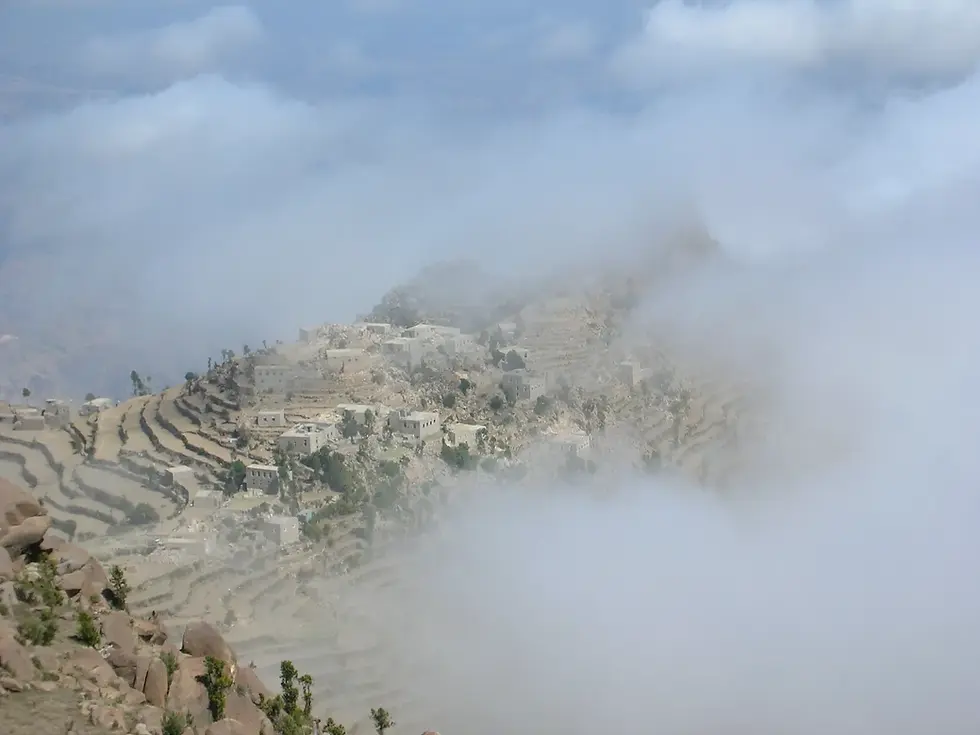
Instead, we stood in a village perched so high on the mountainside that we were literally above the clouds. It was one of the most beautiful things I have ever seen – not just the sights, but the generosity I hadn’t known to expect.
I remember thinking: this feels like a glimpse of heaven. Not only because of the beauty, but because something in me had shifted. The mountain had changed how I saw the people of a land known mostly in the West for the terrorism that took place there. My proximity to these people on a mountaintop changed everything about how I saw them and the world.


(Gebel Sabir in January 2007)
That is what Jesus is doing on the mountain in today’s gospel. He is changing how we see—loosening old assumptions, unsettling inherited categories, and bringing into focus people we have learned not to notice. From the mountain, the world looks different. And once our vision is changed, everything else has to follow.
The Beatitudes are Jesus’ first public teaching in Matthew’s Gospel. This literary form we know as the Beatitudes—”blessed are” statements—was a familiar Jewish form of teaching. Yet, what Jesus says is not typical of that time or ours. And that’s where many of us get tripped up. Because we are often tempted to hear the Beatitudes as poetry instead of proclamation, as comfort rather than confrontation. But Jesus is not describing the world as it is. He is naming the world as God intends it to be, and that naming disrupts every system that depends on power, fear, or exclusion.
This week, Bishop Wright, in his For Faith devotion, talked about how wrong we’ve gotten this. He says, “We seem to prefer the Jesus that is the possession of a nation state and a cheerleader for military might. The only firewall against this attempt at identity theft of Jesus is to let him speak for himself.” He continues, “what Jesus actually blessed was the poor in spirit, those who mourn, the meek, those who hunger and thirst for righteousness, the merciful, the pure in heart, the peacemakers, and those persecuted for righteousness’ sake.”
In other words, Jesus refuses to be drafted into our stories of strength and dominance. He speaks for himself. And what he blesses tells us everything about the kind of kingdom he is bringing near.
Jesus stands among a crowd of ordinary Jewish people living under Roman occupation. He looks out at a crowd made up of the exhausted, the grieving, the poor, the overlooked, and he calls them blessed. He names what God sees when God looks at them. He calls them blessed, not because the world treats them well, but because God is already near to them.
Jesus is establishing the upside-down Kingdom of God here before he does anything else. He’s telling people where to look for those who are close to the heart of God—not to the religious establishment or to the powerful Roman empire, but to the weak and foolish things God uses to confound the strong. He is offering blessing to the marginalized, manifesting God’s power through humility rather than worldly might.
Jesus is not romanticizing suffering or spiritualizing it away. He is naming who already stands close to the heart of God—and in doing so, he quietly reorders the world. The Beatitudes are not a moral ladder we climb. They are what—and who—becomes visible once our vision has changed. Jesus says, “You look to those with power,” but I’m telling you it’s the weak who have something to teach you. You look for God to act in might and force, but I’m telling you it’s peacemaking and mercy and humility that God blesses.
But the reordering Jesus offers does not stop with how we see. Vision always leads to responsibility. Once we begin to see the world as God sees it, the question becomes not what do we believe, but how will we live.
That tension between seeing clearly and living faithfully is not new. The prophet Micah speaks into a moment where God’s people can still see, but have stopped responding. In the passage we heard today, Micah addresses a society that is deeply religious and profoundly unjust—faithful in worship, careful in ritual, and yet willing to ignore the suffering unfolding beneath its prosperity. He condemns the powerful for exploiting the vulnerable, for taking land from the poor, for pushing families from their homes.
To make his point unmistakable, Micah imagines a courtroom scene and summons the mountains themselves as witnesses. The mountains have seen it all. They have watched generations rise and fall. Before those ancient witnesses, God asks a piercing question: What does the Lord require of you?
The answer comes: It’s not more sacrifice. Not louder prayers. Not better religious performance. What God seeks is simple and far more demanding. Only this: to do justice, to love kindness, and to walk humbly with your God.
Both Micah and Jesus confront us with the same unsettling truth: once you have seen clearly, you cannot plead ignorance. But they also know that clarity does not arrive all at once. It often comes back to us later—unexpectedly—when we are no longer on the mountain, when we are trying to return to ordinary life.
Almost ten years after my visit to Yemen, I was scrolling through my phone one evening—looking for something mindless—when a headline caught my attention: “400,000 residents—half the population—are estimated to have fled Taiz.”
Those words startled me awake, because I had stood on those streets. I had met some of those people. And I had not known what was happening to them.
I followed the links and watched the news report. My breath caught in my chest as I saw what had become of that place above the clouds. The city was under siege by Houthi rebels. (Taiz is still suffering today, 11 years later). Most were forced to flee their home but those who remained were trapped without food or medical care. I wondered about that village on the mountainside, about the children we had played with. Were they alive? Were they starving?

(Photo BBC: Taiz, Yemen in 2016)
Now, there are horrors happening in more places than we can count. We cannot keep up with all of it. And often, when it becomes too much, we turn away. But that night, I could not—because the mountain had once taught me to see these people not as statistics, but as neighbors. And with that clarity came responsibility.
I felt such shame—not only because I hadn’t known, but because I had once been given a vision and failed to carry it with me. That moment forced a deeper question—not just what had I seen, but what did faithfulness require of me now? I could not undo the violence. I could not feed the hungry or stop the siege. But I could no longer pretend it had nothing to do with me.
At the time, I was writing for a Christian magazine, and I wrote about what was happening in Yemen. I could not ease their suffering, but I could refuse their erasure. I could help others see. I could invite prayer. I could use my voice to bring awareness.
That small act led to others—writing for nonprofits, amplifying the stories of immigrants and refugees, learning how to stay present to suffering without being consumed by it. I learned that faithfulness does not require doing everything. It requires doing what is ours to do.
And that, I think, is where peacemaking begins. Not with grand solutions or perfect purity, but with the refusal to look away. Peacemaking starts when we allow what we have seen to shape how we live, speak, and act—however partial, however small our response may be.
And this is where the Beatitudes press us—not as abstract ideals, but as a way of living once our vision has been changed. To be poor in spirit is to admit that our vision is limited. To mourn is to let our hearts break open rather than close down. To hunger and thirst for righteousness is to refuse the comfort of silence. To be merciful is to recognize the human cost of every system.
And to be peacemakers is to step into places where truth must be spoken because lives are at stake. Perhaps this is the Beatitude we need most in our day—not because it is comforting, but because it is costly.
Peacemaking is not the wide, easy path. It is more like a narrow ridge high on the mountain, with steep drops on either side. One side tempts us toward avoidance, toward silence that preserves comfort at the expense of truth. The other pulls us toward domination, toward a righteousness that wounds in the name of being right.
Peacemakers learn how to walk that narrow place. They refuse to give up justice for the sake of quiet, and they refuse to give up mercy for the sake of winning. They hold truth without turning it into a weapon. They look across the divide and still recognize the image of God looking back at them.
This way is not natural. It is not efficient. It is not how empires survive. It is, however, how the kingdom of heaven comes near.
Jesus is honest about the cost. When you walk this way, he says, you may be misunderstood. You may be resisted. Blessed are you.
That costly faithfulness is not theoretical. In recent weeks, clergy across the country have spoken publicly about the use of force in our cities, about fear in our communities, and about the deep ache caused by a lack of accountability and the erosion of trust. Yesterday, more than 150 Episcopal bishops, including our own Bishop Rob Wright, released a letter calling the church—and the nation—to reckon honestly with violence carried out in our name, and to respond not with fear, but with faithfulness rooted in the Gospel.
They are not speaking as politicians. They are speaking as pastors—as shepherds who know that when fear takes root, peace cannot flourish.
One of those bishops, Marianne Budde, wrote this week that as we watch national policies of extreme immigration enforcement unfold, many of us may be wondering what is ours to do. She reminds us that each of us can do something—whether that means donating to organizations providing care, supporting media outlets committed to truth, writing our senators, or showing up for our neighbors. She concludes:
“This is a moment for all of us across the nation, and we all can do something. Something large, something small. We can look around and see who among our neighbors is in need of our care… Minnesota is showing us all the way. We can follow their example wherever we are and do what we can to recreate and restore the decency and kindness that sustain us all.”
Jesus does not stay on the mountain. Neither do we. The mountain is not an escape; it is a place of formation. What we see there is meant to shape how we walk once we descend back into our neighborhoods, our conversations, our choices, our public life.
And so the question the mountain places before us is simple, and quietly unsettling: Now that we have seen, how will we walk? What is ours to do?
That question is not meant to accuse. It is meant to awaken us. Because the gospel does not allow us to admire the view and walk away unchanged. Revelation always carries responsibility.
None of us can do everything. But all of us can do something. To speak when silence has felt safer. To listen when we have been quick to judge. To give, to show up, to stand alongside those whose fear has become policy, and to those whose dignity has been called into question.
The Beatitudes show us the world as God sees it. Micah tells us what faith looks like once we have seen. And Jesus invites us not to stay on the mountain, but to be changed by it.
This way is hard. This way is costly. But from the mountain, it is the only way that looks like love.
Amen.


Comments