Sermon: A Love That Does Not Depend on Sight
Easter is not a day. It is a season. For fifty days, the Church lingers in the mystery of the resurrection, walking with the disciples in that strange and holy in-between—after the empty tomb, but before everything fully makes sense. It is a season not just of celebration, but of discovery. Because the question is not only that Christ is risen, but what it actually looks like to live in light of that reality.
What does resurrection faith look like? What does it mean to know and follow a God we cannot see or touch in the ways the first disciples did? What does it mean to love Christ we know but not through the ways we know other realities? And how do we make sense of faith when it doesn’t feel like anything at all?
These are not abstract questions. They are ones we wrestle with every day. I’ve been thinking about them lately alongside someone I love and had important conversations in the last few weeks about what it means to have faith when you don’t “feel” it, when the emotional clarity you expected simply isn’t there. And if I’m honest, those questions are not new to me. I have wrestled with them at various points in my life, trying to understand whether my faith was real if it didn’t always come with certainty, or warmth, or a clear sense of God’s presence.
And the truth is, those questions don’t go away. They deepen. They mature. They become part of the ongoing work of a life of faith.
Because to follow Christ is not to outgrow mystery, but to enter it more fully, to learn new ways of knowing, new ways of trusting, new ways of perceiving a presence that is not always visible, but no less real.
In this reflection for the Second Sunday of Easter, we step into that space with Thomas and with the early Church, and begin to see that faith may not look like certainty at all, but like love that endures, trust that remains, and a different way of seeing.
Listening with you,
Nicole +
Second Sunday of Easter April 12, 2026 Episcopal Church of the Nativity 1 Peter 1:3-9, John 20:19-31
Watch
Listen
Read
There’s a place that has become very dear to me over the last couple of years: St. Columba’s Inverness. It’s a small, beautiful church tucked into a quiet ridge along the Point Reyes Peninsula in northern California. What used to be a redwood mansion now houses this vibrant, deeply faithful community led by a priest who has become a dear friend and mentor of mine, Father Vincent Pizzuto. For the past two weeks, I’ve been there again, walking alongside them through Holy Week.
I first connected to them during my doctoral research and am now considered part of this community even though I’m not there all the time. Sometimes there are long stretches in between my visits. And yet, I love that place. I feel deeply connected to those people. They have shaped me in ways that continue to unfold, in my discernment, in my ministry, in who I am becoming.
And when I talk about this deep connection, people are sometimes a little puzzled. They don’t quite understand how I could become so bound to a place, and to a people, so quickly and so deeply. And honestly, I understand that.
Because we tend to believe that love depends on being there, on proximity, on presence we can see and touch and experience directly. And yet, most of us know that isn’t entirely true, that there is something more to love. We’ve all had the experience of loving people we are not physically with, of carrying places in us that we no longer inhabit, of being shaped by relationships that continue even across distance. There are people, and even places, that live in us. They continue to form us, even when we are not in their physical presence.
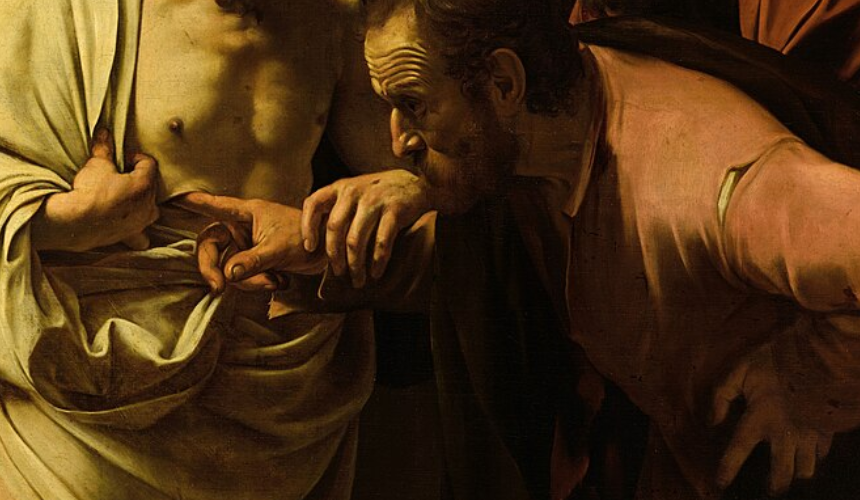
And that’s where our Gospel meets us today. Thomas says what many of us have thought at one point or another: “Unless I see… unless I touch… I will not believe.” And it’s easy to be hard on him, to reduce him to “doubting Thomas,” but I don’t think he’s weak. I think he’s honest. He is giving voice to something deeply human: the desire for certainty.
Because we live in a world that tells us that seeing is believing. If I can verify it, I can trust it. If I can prove it, I can commit to it. And anything less than that feels uncertain, maybe even unsafe. And yet Jesus says something that, at first, sounds almost like a challenge but is actually an invitation: “Blessed are those who have not seen and yet have come to believe.”
Let’s imagine ourselves there for a moment, in that room with the disciples. It’s evening. The doors are locked and they are afraid. Whatever joy the resurrection might bring has not yet settled into them. They are still trying to make sense of what has happened, still unsure of what comes next.
And into that space—into their fear and their uncertainty—Jesus comes and stands among them and says, “Peace be with you.” And then, almost immediately, he shows them his hands and his side. He offers them something tangible and visible. And the text says, “Then the disciples rejoiced when they saw the Lord.”
But Thomas is not there. We aren’t told why. We only know that when the others tell him, “We have seen the Lord,” he cannot receive it as enough. And that, too, feels deeply relatable.
Because it is one thing to hear someone else’s experience of God. It is another thing entirely to have your own, and Thomas wants what the others had. So, he says what, perhaps, many of us would say if we were honest: “Unless I see the mark of the nails… unless I put my hand in his side… I will not believe.”
There is something almost painfully vulnerable in that statement. It’s not just skepticism. It’s longing. It’s the desire not to be left out, not to be asked to build a life on something secondhand, not to have to rely on someone else’s certainty. Thomas is not asking for more than the others received. He is asking for the same.
And what is striking is that when Jesus comes again, because he does come again, a week later, he does not shame Thomas for that desire. He comes into the room again, stands among them again, offers peace again, and then turns directly to Thomas and meets him exactly where he is. “Put your finger here. See my hands. Reach out your hand and put it in my side.”
Jesus doesn’t reject Thomas’s need for something real. He meets it. And yet, even as he meets Thomas’s need, he gently opens a door beyond it. “Have you believed because you have seen me? Blessed are those who have not seen and yet have come to believe.” It’s important that we hear that not as a correction, but as a widening. Because Jesus is not closing the door on Thomas’s experience. He is opening the door to what comes next. He is naming a reality that will define the life of the Church from that moment forward.
He is saying there will come a time when people will not be able to see him in the way the disciples have seen him. They will not touch those wounds. They will not hear his voice in quite the same way. And yet, they will believe. Not because they have any less access to him, but because they will come to know him differently.
And you can almost feel the questions lingering in the room at that point: What does that kind of faith look like? What does it mean to believe… without seeing? What does it mean to know Christ when he is no longer standing in front of you?
And instead of answering that question with an explanation, the Church gives us a picture. It gives us the lives of those who are already beginning to live inside that blessing.
In 1 Peter we brought into the lives of the early Christians to whom Peter is writing, and it is worth lingering there long enough to really see them, because they are not the people who walked with Jesus in Galilee.
They did not see the empty tomb with their own eyes, and they were not in that locked room when Jesus appeared and said, “Peace be with you.” They came later. They heard the witness of others, and they trusted what had been handed down to them. And in that sense, they are much closer to us than they are to Peter.
Their lives, however, are not comfortable or settled. Many of them have been displaced, scattered across regions far from home because of persecution. Their faith is not an abstract idea or a private belief system; it is something that is being tested, stretched, and refined in the real conditions of their lives. It is costing them something to belong to Christ. And it is into that reality that Peter speaks.
Peter, who did know Jesus in the flesh, who did hear his voice and walk beside him, looks at these communities who have never had that experience and says something that, if we allow ourselves to hear it, is almost staggering in its simplicity and its depth: “Though you have not seen him, you love him. And even though you do not see him now, you believe in him and rejoice with an indescribable and glorious joy.”
He does not say, “You believe as best you can under the circumstances.” He doesn’t say, “You are managing without what we had.” He says, quite plainly, “You love him. “And in that moment, something shifts for us.
Because whatever we thought faith was, whatever we assumed it depended on, Peter is showing us something else entirely. He is looking at people who have never seen Jesus and recognizing in them not deficiency, but fullness. He is seeing in them the very thing Jesus named when he said, “Blessed are those who have not seen and yet have come to believe.”
What Peter witnesses in them is not a weaker version of faith, but a different kind of sight. It is the kind of seeing that doesn’t rely on the eyes, but on a deeper attentiveness, a way of perceiving Christ that is not dependent on physical proximity but grows out of trust. And perhaps, as we sit with that, we begin to notice how close this actually is to our own experience.
Maybe you’ve wondered if your love for God is real because you have questions about what the Bible teaches or how the church operates in the world today. Maybe you can’t quite accept certain articles of faith others hold with such ease. You’ve felt the absence of God when you pray or felt nothing at all and wondered what that means for your faith.
If you’ve felt this way, you are not alone. In a particularly dry time in my spiritual life while I was living in Bangladesh, I clung to the letters of Saint Teresa of Calcutta that were released after her death. Since childhood, I had a particular affinity for Mother Teresa, made stronger as I grew because of our common love of the Bengali people. Her writings revealed that this woman the whole world saw as the epitome of Christian faithfulness and service experienced a nearly 50-year dark night of the soul marked by a severe and constant sense of the absence of God.
For me, this revelation was a deep comfort because it replaced my ideas of love as warm feelings of God’s nearness with the reality that loving Christ is so much more. As Saint Teresa said, “We must know exactly when we say yes to God what is in that yes. Yes means, ‘I surrender,’ totally, fully, without any counting the cost” and for her that meant accepting whatever God gave – or took away. For her, it meant not feeling Christ near and yet serving him in the poor and dying anyway.
When Peter says, “you love him,” to the early church he is not describing a passing emotional experience, something that comes and goes depending on how close they feel to God in a given moment. He doesn’t praise them because they made a certain statement of faith or because they had the right answers.
Their love for Christ is not sustained by sight; it is sustained by a steady, lived commitment, by a willingness to continue orienting themselves toward him even when they cannot see him, even when their circumstances are difficult, even when their faith is being tested.
And so, Peter can say, without exaggeration, that they rejoice with an indescribable and glorious joy. Not because their lives are easy or because everything makes sense, but because Christ is not absent to them. He is present, in a way that is no longer confined to one place or one moment but is encountered in the very fabric of their lives—in their endurance, in their hope, and in their shared life together.
This is the kind of love that is not driven by emotion alone, but by a deeper act of the will, a love that shows itself in faithfulness and obedience. In the same way, our faith is not a matter of having all the right thoughts or arriving at perfect certainty. It is, at its heart, an act of trust. It is the decision, again and again, to trust even in the absence of visible proof.
And this is where the resurrection we celebrated last week begins to reveal its full meaning. It is not simply that Jesus has been raised from the dead, as astonishing as that is. It is that in being raised, he is no longer present in the way he once was.
This is one of the most valuable lessons I’ve learned from my friend Vincent Pizzuto in these last two years, as he writes in his book Contemplating Christ. He says this as he reflects on the resurrection and ascension, helping us see them not as moments of absence, but as the beginning of a deeper, more expansive presence. He says, “Christ must be understood not as having gone anywhere, but as having gone everywhere.”
His presence is no longer limited to those who can see him or stand near him. Instead, he becomes available in a new way, a deeper way, a way that is not bound by geography or time but is known through love and through a life that abides in him.
And so, faith becomes something different than we imagined. Not certainty built on what we can prove, but a way of seeing that is formed over time— in love, in trust, in the quiet decision to remain. And slowly, we begin to realize that we are not waiting to see Christ at all. We are learning to recognize the ways he is already here. And that recognition comes not through sight alone, but through a life that has learned to love him.


Comments